

Emma MacNeill
Charlie Wanti Art
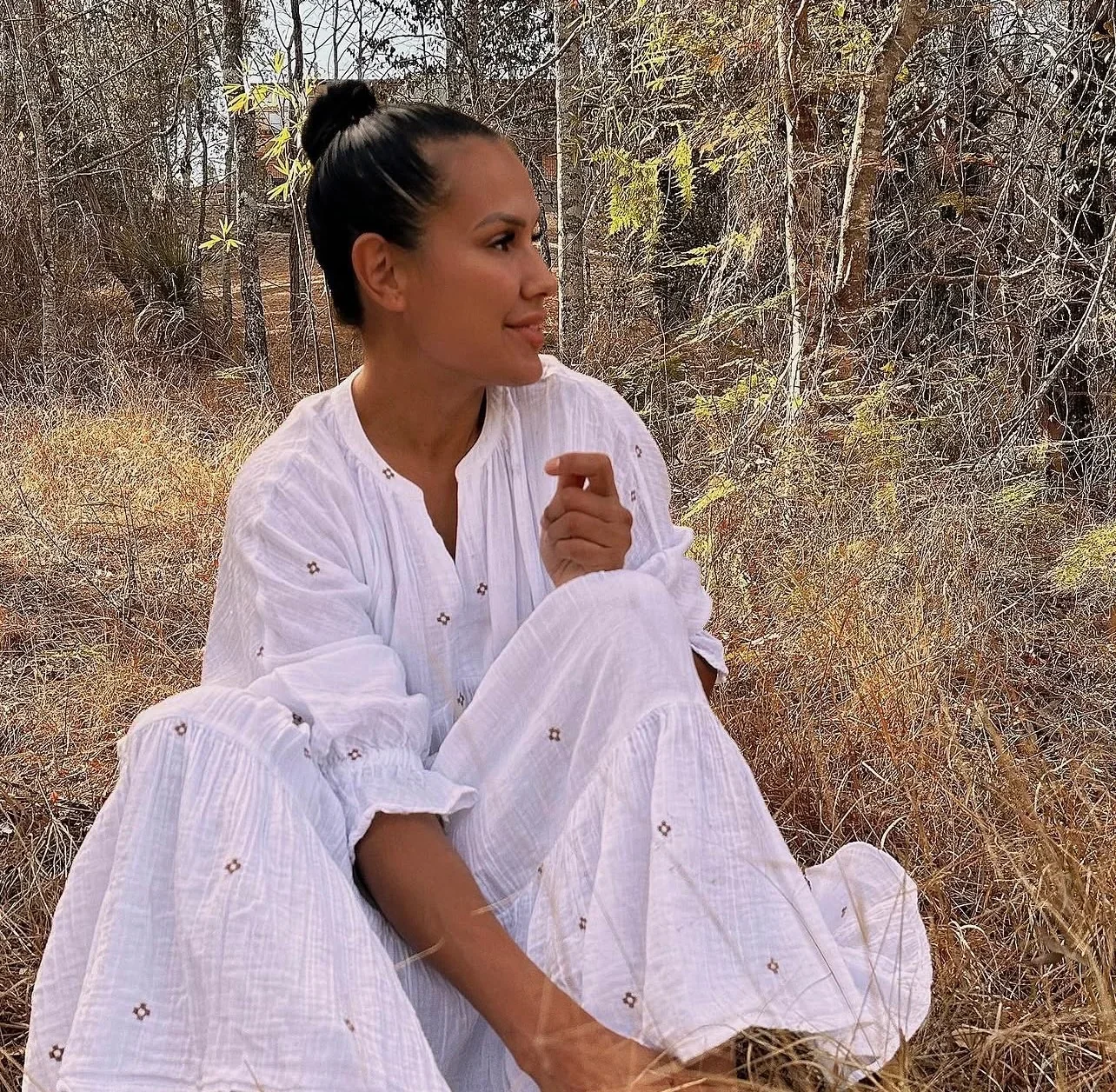
My name is Emma MacNeill, and I am a proud Yamatji Martu woman born and raised in the small rural town of Kununurra, in the heart of the Kimberley, Western Australia.
My mother’s family descends from the mighty Western Desert and the small rural town of Meekatharra. My Grandmother is one of the last Traditional Landowners of her generation, and my Grandfather is one of the last Traditional Lore Men still practising and passing on our cultural knowledge today.
Our connection to Barna (Country) is at the heart of our identity. It is where our stories live, where our healing begins and where our strength comes from.
My art has been passed down to me through my Mother and Grandmother, who come from a deeply rooted and enduring bloodline of storytellers who carry the knowledge and traditions of those who came before them.
My art is more than just something I create; it is a continuation of stories that have lived within my family and bloodline for generations.
artworks
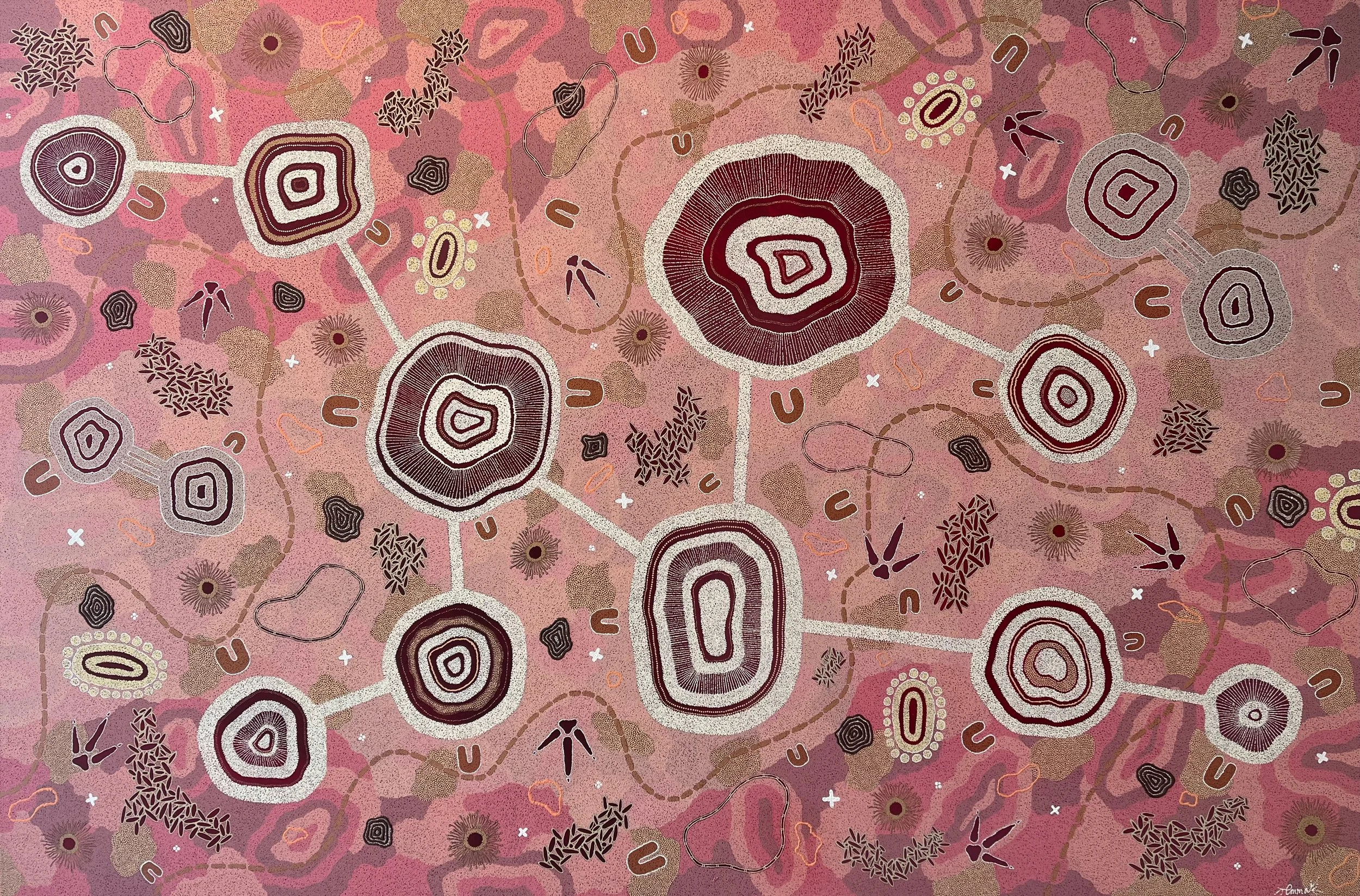
Acrylic on canvas
105 x 156 cm (framed)
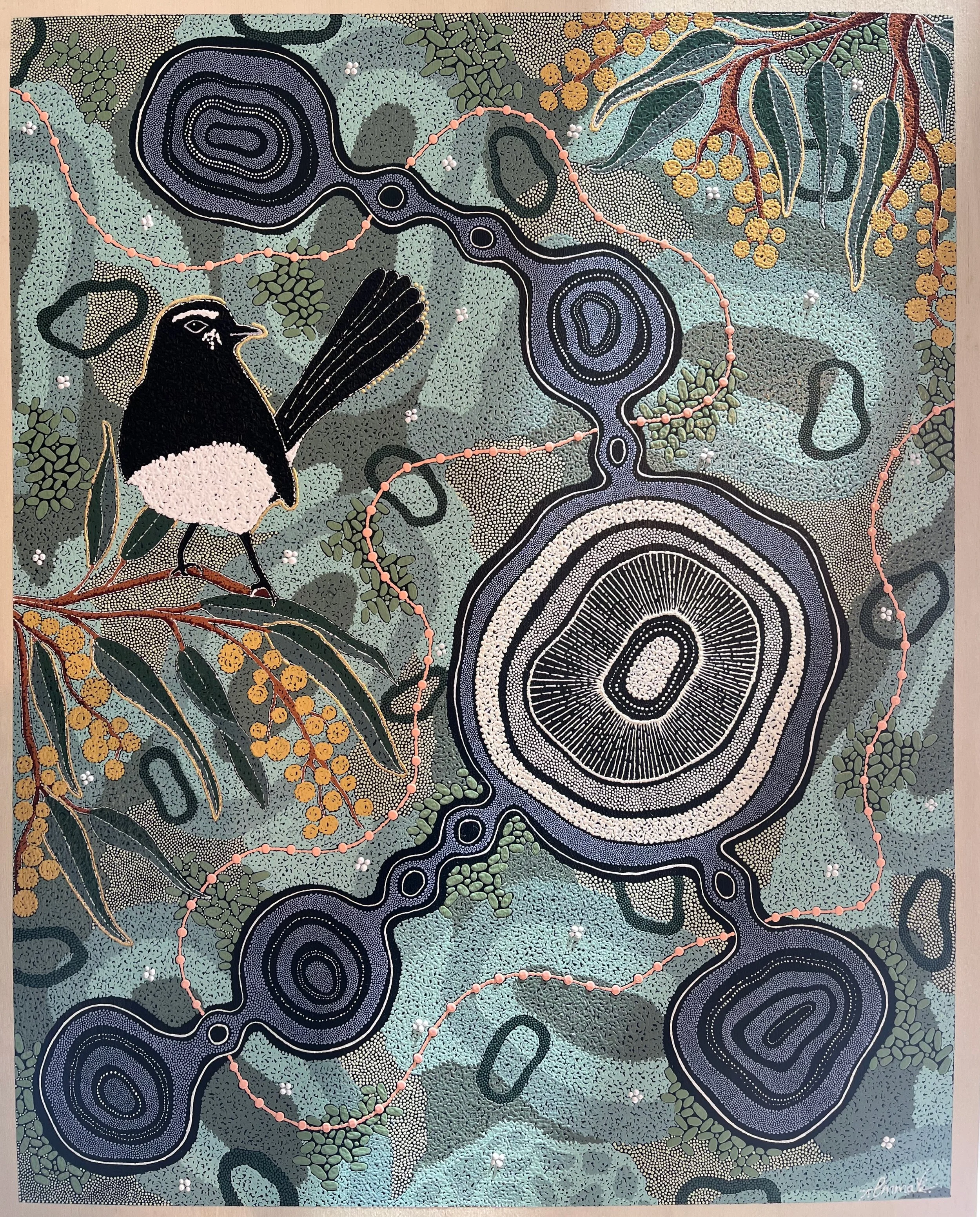
Acrylic on board
51 x 41 cm
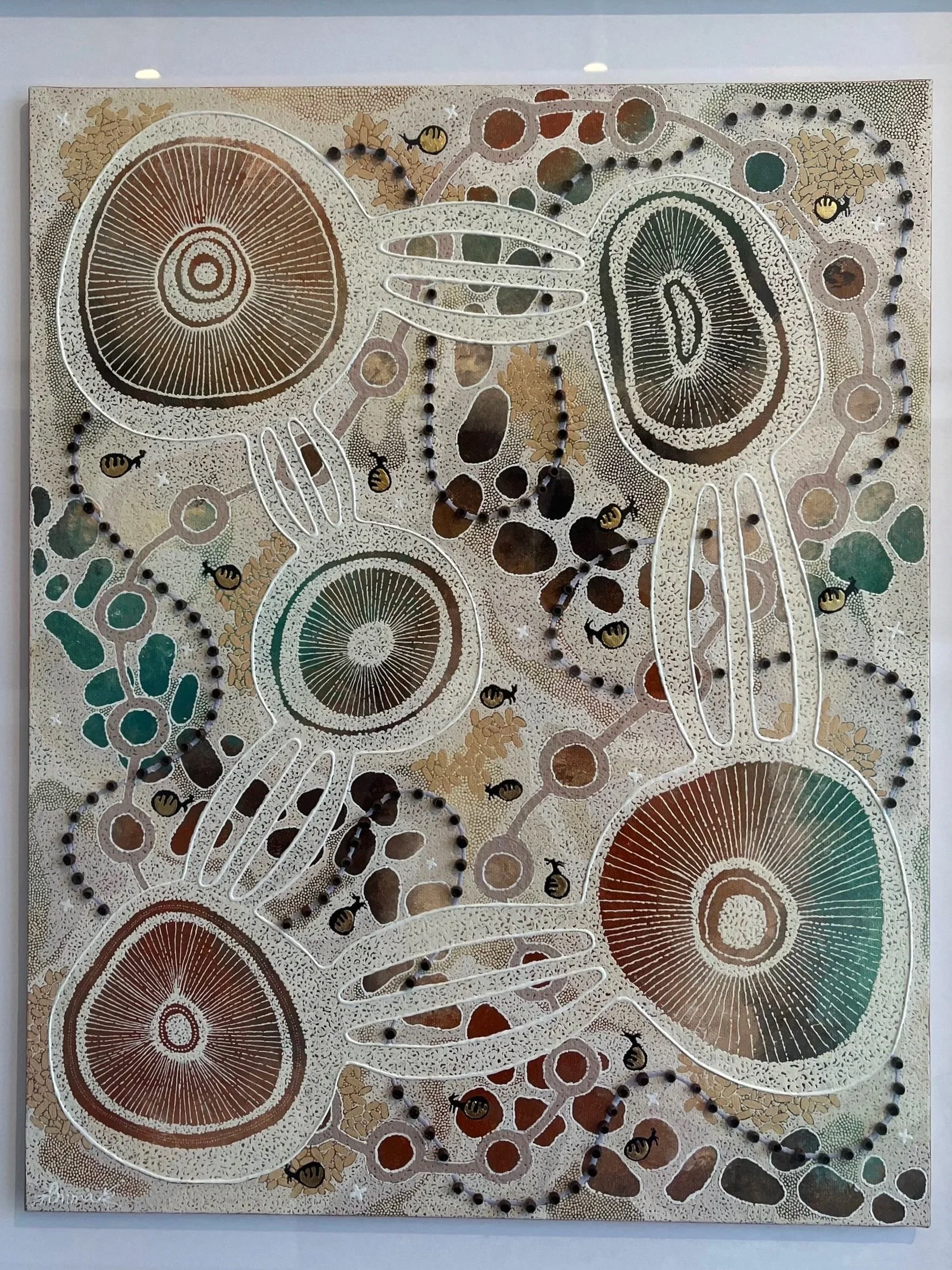
There’s something incredibly special about the Djiti Djiti (Willy Wagtail). For many, these beautiful little birds are more than just visitors. They are believed to be spiritual messengers, carrying the love and presence of those who have passed on.
Sometimes they appear when we least expect them, but perhaps when we need them most. A gentle reminder that the people we love never truly leave us, and that their spirit remains close, watching over us.
When a Djiti Djiti comes to visit, take a moment to think of someone you love and miss. Perhaps it’s their way of letting you know they’re still with you, bringing comfort, connection and a little peace to your heart.
And most importantly, don’t be afraid to talk to them. Say the things you wish you could say, share a memory, or simply enjoy their company for a moment.
Because maybe, just for that moment, it’s only you two.
— Emma MacNeill
Charlie Wanti Art
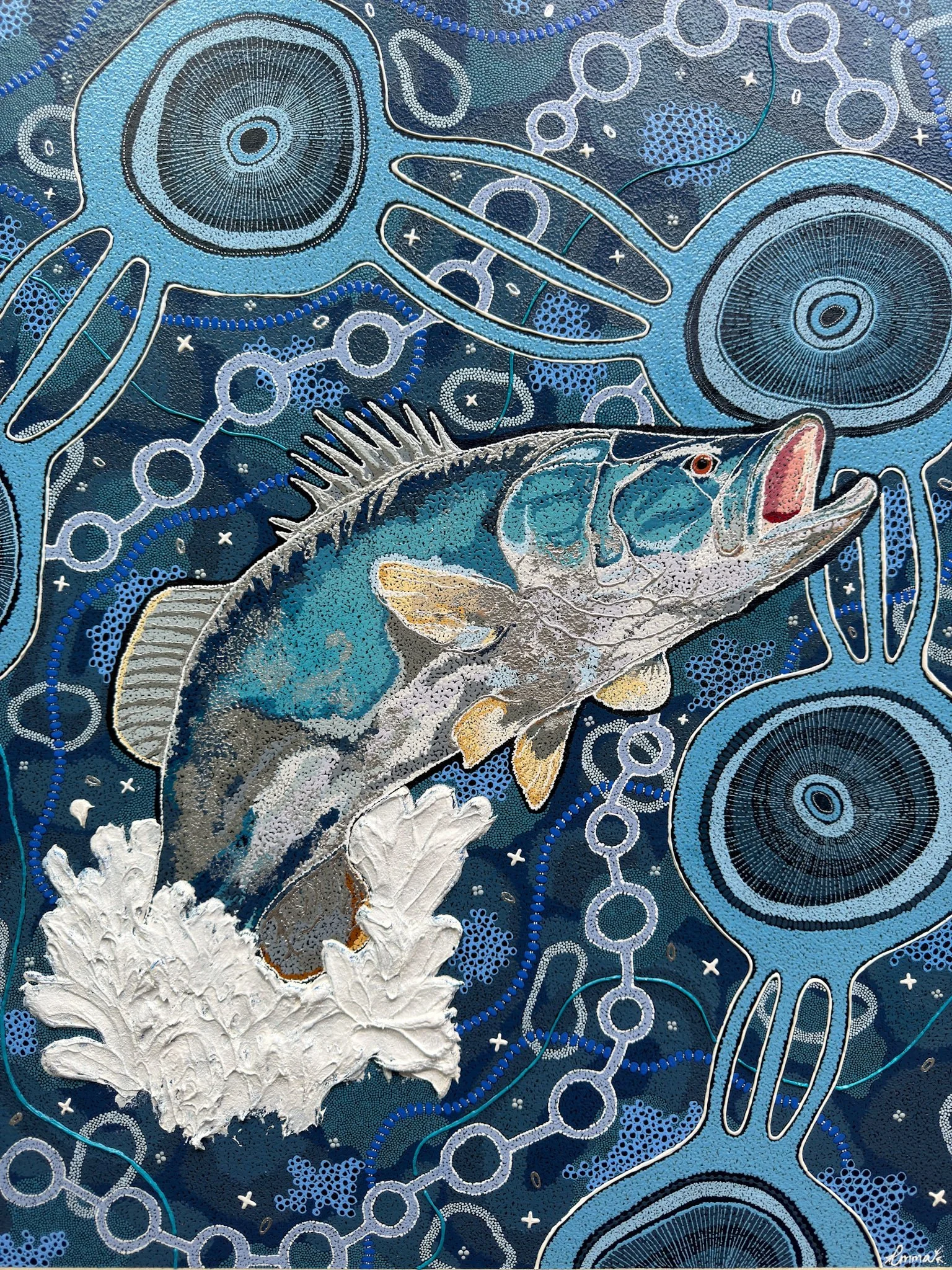
Mixed media on board
61 x 46 cm
Some of my most treasured childhood memories are of travelling through the Kimberley with my dad and brother, exploring Country, camping beneath the stars and spending our days fishing along the rivers.
Fishing was never just about catching a fish. It was about family, connection, adventure and the memories we created together.
I still remember the excitement of catching my very first barramundi, but one particular fishing trip has stayed with me throughout my life.
Dad, my brother and I travelled to the Keep River with some of our closest family friends for a weekend of camping and fishing. We had our own little competition called King of the Keep, where whoever caught the biggest barramundi would earn the title and a special T-shirt.
The Keep River was wild and beautiful, its waters home to countless crocodiles. We had to be careful and respectful of our surroundings, but that was all part of growing up and learning about the land and waterways around us.
Sitting around the campfire with Dad and my brother, sharing stories and laughter. Running barefoot through the bush, exploring without a care in the world. Sitting quietly beside the river, listening to the sounds of nature, the fruit bats in the trees and the occasional enormous splash breaking the stillness of the water.
There was a freedom and peacefulness in those moments that is difficult to put into words.
Looking back, I realise how precious those experiences were. They shaped my connection to Country, my love for nature and the importance I place on family and the simple moments we share.
This barramundi painting is more than a representation of a fish. It is a reflection of my childhood, my family and the memories that will forever connect me to the Kimberley.
Every time I look at a barramundi, I am reminded of those adventures with my dad and brother, the excitement of the river and the beautiful simplicity of growing up surrounded by family, nature and Country.
Through this artwork, I hope to share a little piece of those memories and celebrate the way fishing brings people together, connecting generations through stories, laughter and experiences that stay with us for a lifetime.
— Emma MacNeill
Charlie Wanti Art
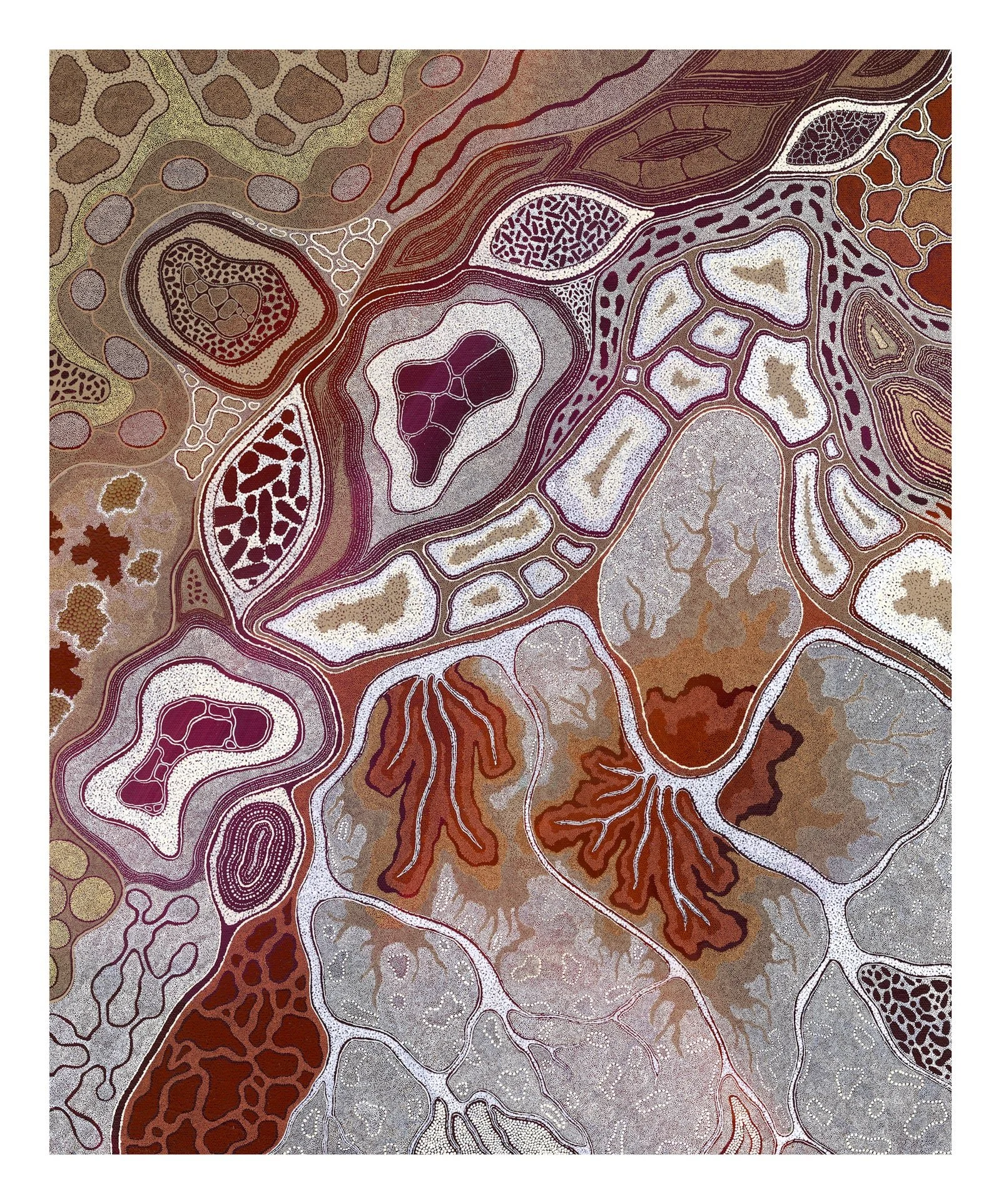
Acrylic on board
76 x 66 cm (framed)
Some memories never leave us. They stay quietly within us, waiting for the moment they find their way onto a canvas.
As a young girl growing up in Kununurra, I would travel to Perth to attend boarding school. Those journeys meant boarding a plane and spending hours flying above the vast and beautiful landscapes of Western Australia.
As we travelled across the country, often over the remote landscapes surrounding the Pilbara and Western Desert region, I would find myself gazing out of the window, completely captivated by the beauty below.
It was the salt lakes that always caught my eye.
From high above, they looked like enormous paintings spread across the earth. Beautiful patches of white salt contrasted against the surrounding land, while intricate shapes, colours and natural formations connected and flowed into one another.
Every lake was different. Every formation told its own story.
Even as a child, I remember thinking how much the landscape resembled a work of art. The earth itself was the artist, creating these extraordinary patterns that could only truly be appreciated from above.
I didn’t realise it at the time, but those images were becoming part of me.
Years later, when I began creating this piece, I found myself returning to those childhood memories. I wanted to capture what I had seen through that little aeroplane window — the striking white salt, the changing formations of the land, and the beautiful way everything connected.
Salt Lakes is my interpretation of the land from a bird’s-eye view, inspired by the beauty I witnessed as a young girl travelling across Western Australia.
It is more than a painting of a landscape. It is a memory of my childhood, a connection to the country I grew up in, and a reflection of the beauty that has stayed with me throughout my life.
What I once admired through the window of an aeroplane has now found its way onto my canvas.
— Emma MacNeill
Charlie Wanti Art
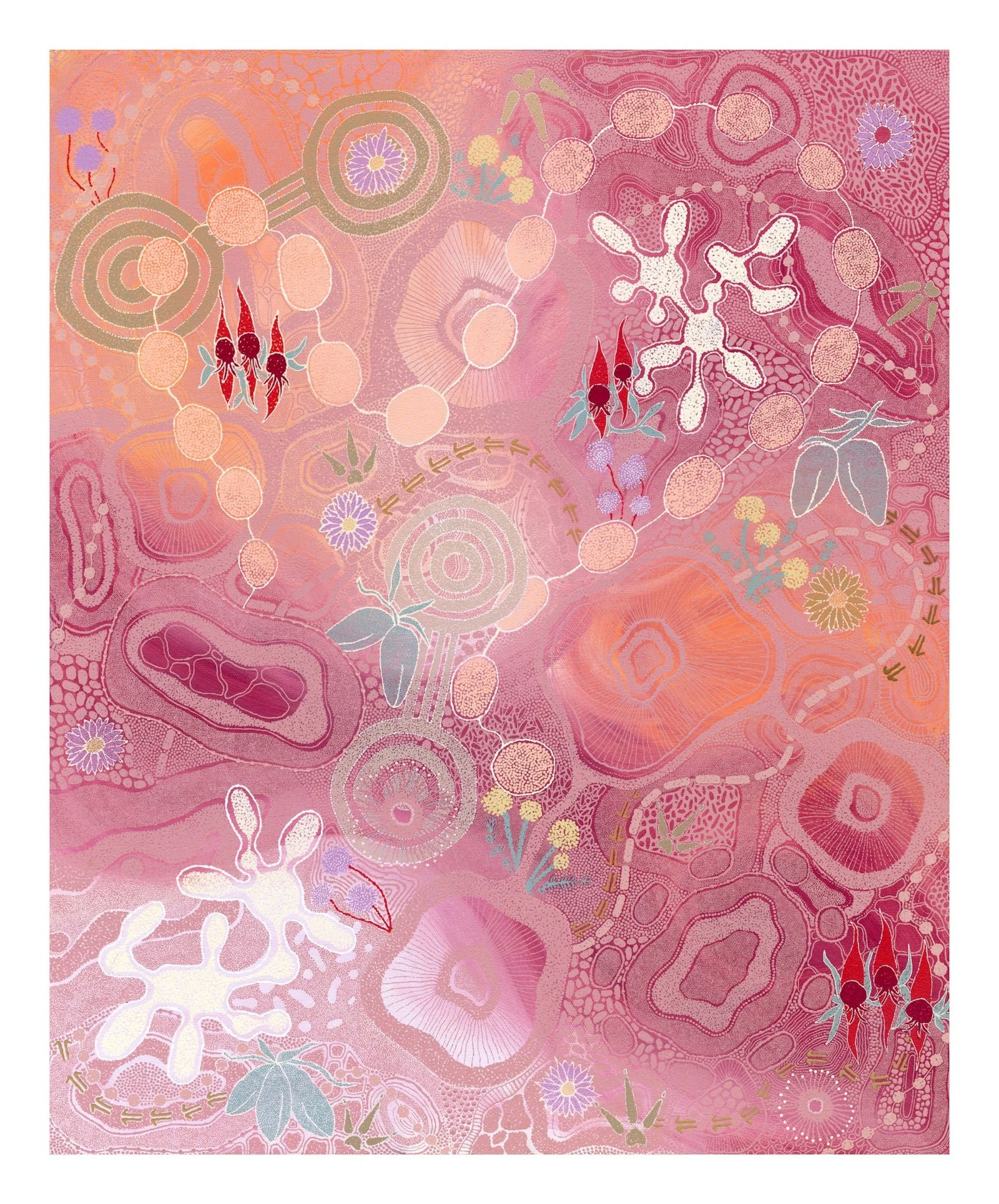
Acrylic on board
76 x 66 cm (framed)
Some of my most treasured childhood memories are of travelling through Country with my Nana, surrounded by the vast and beautiful landscapes of Western Australia. From the Goldfields and the Pilbara to Kalgoorlie, Leonora and Meekatharra. I remember the endless stretches of red earth, the spinifex, and the delicate wildflowers that would emerge from the desert as the seasons began to change.
Among them were the beautiful red Desert Peas, flowers I have always associated with my Nana. To this day, seeing them takes me back to those moments spent together on Country. But these flowers hold a meaning far deeper than their beauty.
I remember travelling through the bush with my Nana, sometimes on our way out kangaroo hunting, when she would point out different plants and flowers growing across the landscape. I remember her showing me delicate purple flowers and explaining how they were used to help people suffering from asthma.
To others, they may have appeared to be ordinary wildflowers scattered across the desert. But to my Nana, each plant carried knowledge, purpose and a connection to Country. She taught me to see beyond their colours, to understand that even the smallest flower had its place and its own story.
There is something incredibly beautiful about the desert when the seasons change. What was once a seemingly endless landscape of red earth and hardy spinifex suddenly comes alive with colour. Delicate, paper-thin petals emerge from the harshest conditions, alongside vibrant flowers and striking, spiky blooms.
These are not the soft, lush flowers we commonly see in gardens. They are resilient. They are delicate yet strong. They belong to the land, shaped by its conditions and flourishing in their own time.
That is what I wanted to capture in Desert Flowers.
Not simply the beauty of wildflowers, but the memories they carry. The long drives through Country. The changing seasons. The colours of the desert coming alive. And, most importantly, the voice of my Nana, sharing her knowledge as she pointed out the flowers growing beside us.
As an Aboriginal woman, these memories are deeply precious to me. They remind me that our connection to Country is not only found in the land itself, but in the stories, teachings and moments shared with those who came before us.
Every flower in this painting represents something greater than its physical beauty. It represents remembrance, resilience, family and the passing of knowledge from one generation to the next.
Desert Flowers is my way of honouring those memories and the woman who helped me see the beauty, purpose and stories held within Country.
— Emma MacNeill
Charlie Wanti Art